




The word vertigo is derived from the Latin phrase verto, which means “to revolve.”
Vertigo is a false sense of motion, spinning, or feeling of imbalance. Sufferers often call it dizziness, imbalance, light-headedness, or “ “chakkar aana in Hindi.” Often, the imbalance is associated with nausea, vomiting, difficulty in focusing on moving objects, headaches, changes in hearing or ringing in the ears, and difficulty in concentration or unsteadiness while walking. It may worsen when you move your head. Their symptoms can come and go and can range from a few seconds to minutes, hours, or even days.
15% of people have dizziness and balance disorders.

Vertigo is not a disease; it’s only a symptom. Therefore, suppressing the symptom is not the solution.
Proper vertigo diagnosis of what is causing vertigo/dizziness is possible only when the doctor makes a systematic evaluation. A neuro-otological (ear and brain) workup alone will help to find out if a vertigo patient is suffering from disorders like BPPV, Meniere’s Disease, Vestibular Neuritis, Labyrinthitis, Acoustic Neuroma, Otolith Dysfunction, Vestibular Migraine, Central Vestibulopathy, or psychogenic disorders.
Different disorders causing vertigo have different presentations and require diverse treatment protocols. A correct diagnosis will enable the doctor to offer the right vertigo treatment, which is the only way to give the patient lasting relief.


Patients suffering from persistent or intermittent dizzy intervals of vertigo usually describe their symptoms as:






It is a disorder of the inner ear, characterized by episodes of hearing loss and fullness in one ear, tinnitus, and vertigo. Meniere’s Disease is caused by increased pressure of the inner ear fluid. If not treated timely, it can lead to progressive hearing loss.
Vestibular Neuritis is caused by a viral infection leading to inflammation of the vestibular nerve. This disturbs the balance function and causes dizziness. The symptom is accompanied by blurred vision, nausea, vomiting, and difficulty focusing during head movement. Early vestibular rehabilitation helps ensure rapid recovery.
Damage to the otolith organs (utricle and saccule) cause disequilibrium of the body and affects visual stability. Until recently, there was no precise method to check the impairment of otolith organs. But now Otolith disorders can be diagnosed with the Subjective Visual Vertical test and VEMP. Otolith stimulation through vestibular rehabilitation therapy works well in treating the disorder.
10% of the population is affected by a migraine, most of them are women. The most common presentation of a migraine is headaches. But in a vestibular migraine, the patient has dizziness which may be associated with headaches. A severe headache coupled with dizziness indicates a vestibular migraine. Along with the spinning sensation associated with headaches, motion sickness and hypersensitivity to light and sound prominently show up in the patient. A vestibular migraine is controlled with diet and lifestyle modifications. In cases of frequent dizzy spells, migraine prophylaxis is prescribed.
The unusual movements of carbonate crystals from their chamber into fluid-filled semicircular canals disturbs the way the balance nerve senses gravity and adjusts its movement. The result is vertigo or the sensation of spinning. BPPV is a common cause of vertigo. It is seen more frequently in the older population, after an ear infection, head injury, surgery or after prolonged rest. But often the trigger is unknown.The canalith repositioning exercises are the best method to cure dizziness caused by BPPV in which the offending particles are repositioned according to the type of BPPV by manoeuvres like Epley Manoeuvre, Semont Manoeuvre etc.
The infection causes labyrinthitis in the labyrinth of the inner ear leading to vertigo, hearing loss and tinnitus. The difference between labyrinthitis and vestibular neuritis is; in labyrinthitis both vestibular and cochlear nerves are affected and cause dizziness, ringing in the ear and hearing loss. While in Vestibular neuritis only vestibular nerve is affected leading to vertigo but the hearing ability is not affected. Labyrinthitis causes severe dizziness bouts that may last for days! Vestibular suppressants may be prescribed by the doctors to treat dizziness and its associated symptoms, for a very short duration of 3 to 5 days. Vestibular rehabilitation should be started at the earliest to ensure rapid recovery.
Dizziness, fullness in the ear, vertigo spells are the symptoms of perilymph fistula. A small tear in the fluid-filled inner ear causes fluid to leak into the middle ear. This leakage disturbs the equilibrium and leads to vertigo spells, especially when the patient does straining activities or coughs vigorously. This condition may also lead to tinnitus and hearing loss. Videonystagmography (VNG) and vestibular examination help diagnose the presence of the perilymph fistula.
The compression of the vestibular nerve due to an inflamed blood vessel, radiation, surgery, or vestibular neuritis may cause vestibular paroxysmia. Microvascular compression is the most common reason for vestibular paroxysmia. The patient may have frequent short spells of vertigo episodes recurring throughout the day. VNG/ ENG and MRI scanning are recommended to diagnose Vestibular paroxysmia.
A rare condition of SSCD may occur as a result of thinning, or damage to the bony part of the labyrinth. It affects the patient’s hearing ability too. Natural coughing or sneezing can trigger dizziness in this condition. These patients have an extreme sensitivity to loud sound. VNG guided Valsalva manoeuvre, VEMP and CT scan of the temporal bone confirms SSCD. The treatment for SSCD is to avoid actions which aggravate dizziness. Surgical repair of the bony dehiscence is advocated for lasting results.
The patient experiences a continuous rocking or sense of motion as a result of long travel, either by ship or aeroplane. Some individuals may develop MdDs even without exposure to long travel. A thorough vestibular evaluation and studying the history of the patient can diagnose MdDS. Antidepressant medication is prescribed to treat the swaying sensation. Vestibular rehabilitation treatment is the best technique to treat MdDS. Virtual reality training is also advised for these patients.
Acoustic neuroma is a noncancerous growth on the balance nerve which causes unsteadiness, dizziness, facial numbness or tingling sensation, change in taste etc. A tumour grows slowly, and hence the patient often does not notice the symptoms. However, it may prove life-threatening if a tumour grows big enough to press on the brain stem. Surgery and radiation are widely used methods to treat acoustic neuroma.
Multiple sclerosis is an autoimmune disorder in which the protective myelin shield of the nerve cells get damaged hampering signal transmission to the brain. Difficulty in focusing, visual problems, vertigo spells and unsteadiness are some of the symptoms of multiple sclerosis. Spinal tap, VNG and MRI brain are advised in the evaluation to confirm multiple sclerosis.


Vertigo is a feeling that everything around you is spinning, even when you’re standing still. There are two main types of vertigo:
This kind happens when there’s a problem in your inner ear, which helps with balance. Some common causes are:
Symptoms: Spinning sensation, dizziness when moving your head, ringing in the ears, feeling off balance.
This type is caused by problems in your brain, especially areas that control balance. It can happen due to:
Symptoms: Dizziness along with other signs like trouble speaking, muscle weakness, or trouble seeing clearly.
Sometimes vertigo doesn’t just happen on its own. It can be linked to other health problems in your body. Here are two important ones to know about:
In conditions like vestibular migraines, the brain reacts differently to movement, which can lead to a cycle of feeling dizzy and anxious at the same time.
Vertigo Type | Key Differentiator | First-Line Treatment |
BPPV (Benign Paroxysmal Positional Vertigo) | Triggered by specific head movements; short, intense episodes | Canalith repositioning maneuvers (e.g., Epley) |
Vestibular Neuritis | Sudden onset; associated with viral infection; no hearing loss | Vestibular suppressants; corticosteroids |
Labyrinthitis | Similar to neuritis but includes hearing loss | Vestibular suppressants; antibiotics if bacterial |
Ménière’s Disease | Recurrent vertigo with hearing loss, tinnitus, ear fullness | Low-salt diet; diuretics; vestibular suppressants |
Vestibular Migraine | Associated with migraine symptoms (light/sound sensitivity) | Migraine prophylaxis; lifestyle modification |
Central Vertigo | Originates from brain (stroke, Multiple Sclerosis); may have neurological signs | Treat underlying cause; neurology referral |
There are various tests to diagnose vertigo and its cause.
NeuroEquilibrium is a leader in using cutting-edge technology to conduct a proper vertigo test to identify the underlying cause. Advanced Vertigo and Balance Clinics worldwide use ultra-modern differential dizziness diagnosing devices to evaluate symptoms and the severity of dizzy spells in real-time.
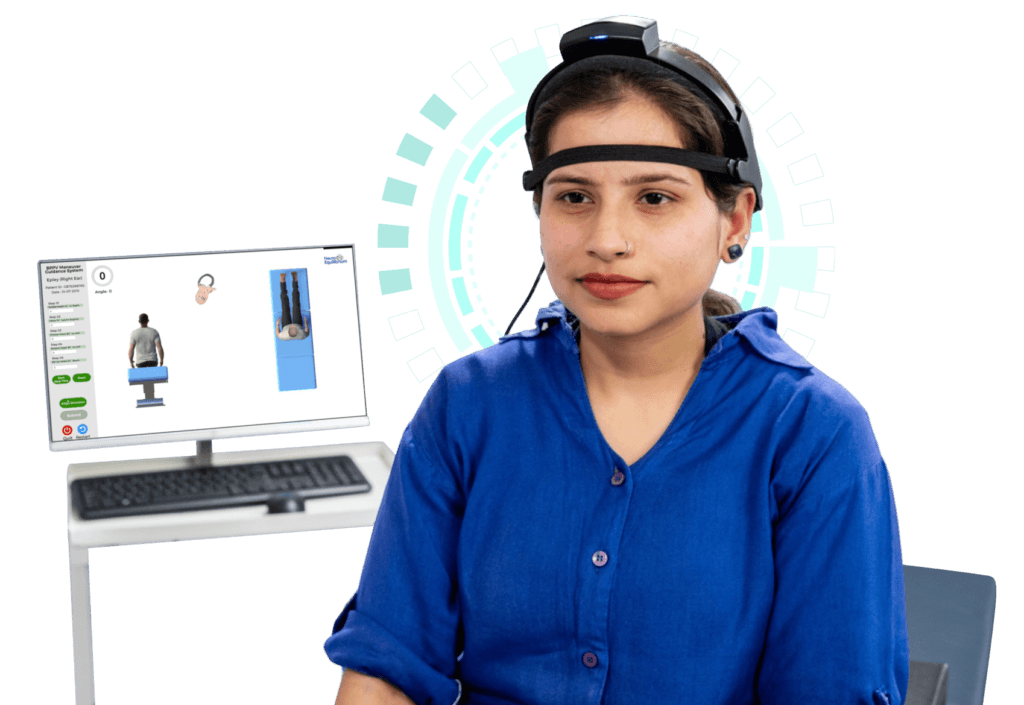
The doctor will look for any abnormal eye movements and ascertain that the ability to follow objects is normal. The doctor evaluates the involuntary eye-movements (nystagmus) of the patient. The rapid eye movements induced due to head maneuvers by the doctor may suggest in which ear the problem lies.
Tests are done on diagnostic devices such as Videonystagmography (VNG), Craniocorpography (CCG), Subjective Visual Vertical (SVV), computerized Dynamic Visual Acuity (DVA), and VEMP to identify the cause of the balance disorder in the patient.
The frequency and severity along with the associated symptoms need to be considered for appropriate treatment of each patient.
Most people do not believe that their condition of imbalance can be cured. But fortunately, vertigo is curable. It is essential to get timely vertigo treatment to return to a healthy life as soon as possible. Here are a few ways:
Vertigo is only a symptom. Diagnosis of the underlying cause using various diagnostic tests like VNG etc. is essential for correct treatment.
Vestibular Rehabilitation exercises and Canalith Repositioning Manoeuvres are prescribed for appropriate Vestibular problems. Vestibular rehabilitation exercises are very useful in gaining balance, normalising visual disturbance and reducing dizziness in a short span of time. Canalith Repositioning manoeuvres are done for patients suffering from BPPV. The type and side of BPPV are diagnosed, and then the recommended repositioning manoeuvre like Epley manoeuvre, Semont manoeuvre, Barbeque manoeuvre etc. is performed.
They are prescribed for appropriate Vestibular problems and are very useful in gaining balance, normalizing visual disturbance, and reducing dizziness quickly. Canalith Repositioning Maneuvers are done for patients suffering from BPPV. The type and side of BPPV are diagnosed, and then the recommended repositioning maneuver like the Epley maneuver, Semont maneuver, Barbeque maneuver etc. is performed.
Medications are prescribed as the first line of treatment to control the severity of dizziness and the discomfort that accompanies it, such as nausea, fatigue, anxiety, vomiting, difficulty in focusing, visual disturbance etc. Often patients with Vertigo are given medicines like Vertin, Stugeron, Meclizine Hydrochloride, Stemetil etc which suppress the symptoms. Taking these medications for a prolonged duration is dangerous. They should not be given for more than 5 days.
Surgery is advised for rare cases of vestibular disorders as inner ear surgeries are quite complex.
At NeuroEquilibrium’s speciality clinics, we use virtual reality to make vestibular rehabilitation therapy more effective and provide long-lasting relief. Currently, we are the only one in India to do so. The exercises are designed to cater to various needs of vertigo patients, physically, physiologically and psychologically. Every patient is put on a customised Vestibular Rehabilitation therapy, keeping his condition, severity and other associated problems and medical conditions in view.
Our methods in providing personalised vertigo treatment enable us to map the patient’s improvements efficiently and alter the line of treatment if required. Such regular review of treatment and response is necessary to provide quick and long-lasting relief to vertigo patients.
Some things can make you more likely to get vertigo, including:
If you suddenly feel dizzy or like the room is spinning, here’s what you can do:
If you get vertigo often, some small changes in your daily routine can help:
Vertigo is a sensation of spinning or dizziness that can result from an inner ear problem or disturbance of the balance center of the brain which makes you feel like you are moving or your surroundings are moving. Vertigo, although not a disease itself, is a symptom of different diseases, including Benign Paroxysmal Positional Vertigo (BPPV), labyrinthitis, or vestibular migraine. If it interferes with balance, you may find you can’t walk straight or stay upright. The time vertigo lasts is determined by the underlying cause. It can last a few minutes up to hours, to some days in a few cases.
Issues in the inner ear or brain typically cause vertigo. Benign Paroxysmal Positional Vertigo(BPPV) is the most common cause and occurs when tiny calcium crystals in the ear canal shift and interfere with balance. Other causes include Meniere’s disease due to fluid buildup in the inner ear, and an inflammation of the nerves linking the ear to the brain (vestibular neuritis). Vertigo can also cause migraines, head injuries, or be a side effect of medications. Sometimes, vertigo results from central causes such as strokes or brain tumors.
Symptoms of vertigo include a spinning or whirling sensation, where individuals feel like they or their surroundings are moving. This dizziness is often accompanied by nausea, vomiting, and difficulty with balance. Some people may experience sweating, abnormal eye movements (nystagmus), or a ringing sensation in the ears (tinnitus). Symptoms can last a few seconds to several hours or more, depending on the cause. In severe cases, vertigo can interfere with daily activities, making it hard to walk, stand, or even sit upright without feeling dizzy.
The treatment for vertigo depends on its cause. The Benign Paroxysmal Positional Vertigo (BPPV) involves a series of head movements a doctor performs for the different maneuvers that can dislodge the crystals that have moved in the canals and relieve symptoms. Symptoms can be managed with medications such as antihistamines, vestibular suppressants, and anti-nausea drugs. In cases due to infection, antibiotics or antiviral drugs are sometimes required. Vestibular rehabilitation therapy (VRT) is also able to help the brain relearn how to compensate for loss of balance. Severe or treatment-resistant vertigo may require surgery in rare cases.
Yes, vertigo can significantly impact daily activities such as driving, working, and social interactions. It can cause dizziness, imbalance, and difficulty concentrating.
A neuro-otologist is a specialist who diagnoses and treats disorders of the ear, nose, and throat that affect balance and hearing. They can provide accurate diagnosis and recommend appropriate treatment, including vestibular rehabilitation therapy and medication.
NeuroEquilibrium is a specialized clinic that offers comprehensive diagnosis and treatment for vertigo. Their experienced neuro-otologists utilize advanced diagnostic tools and personalized treatment plans to help patients regain their balance and quality of life.
Vertigo, Headaches, nausea, or ringing in your ears? Find its root cause. Talk to expert.

